



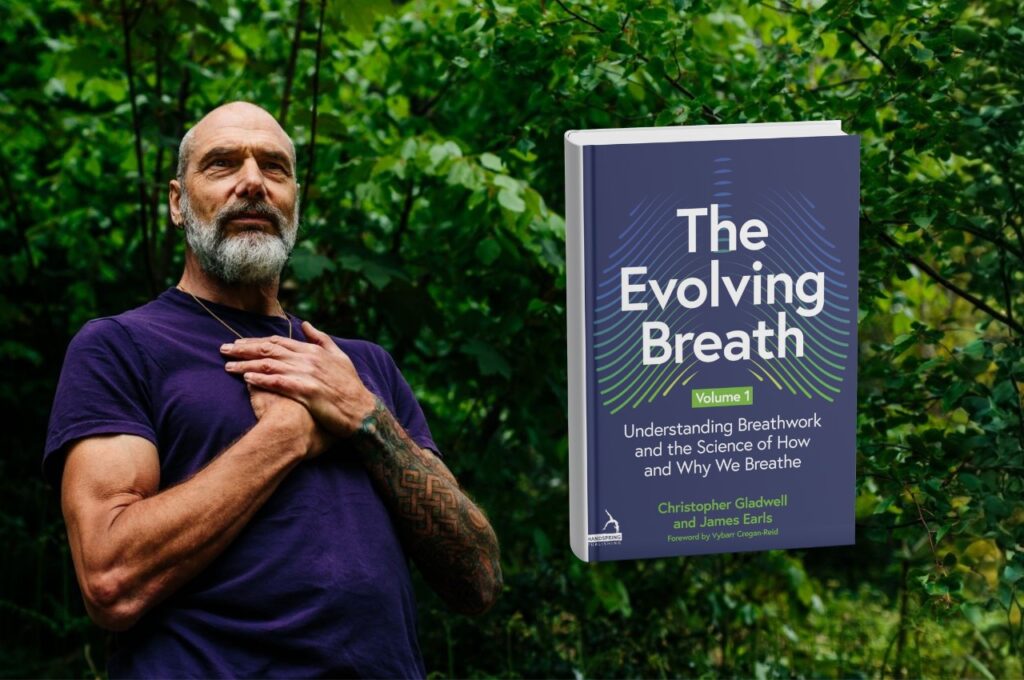
Interview with Christopher Gladwell, co-author of The Evolving Breath
At this year’s MBS Wellbeing Festival, we’re delighted to feature Christopher Gladwell, an internationally respected teacher of breathwork, mindfulness, and embodied awareness. Together with James Earles, Christopher co-authored The Evolving Breath, a groundbreaking and beautifully illustrated guide that bridges ancient wisdom with modern science. The book explores how our breathing has evolved, how it reflects our physiology and psychology, and how reconnecting with the innate intelligence of breath can restore balance, vitality, and clarity in today’s fast-paced world.
In this conversation, Christopher shares insights from his work and reflections on how we can breathe, and live, more consciously.
Christopher, what first inspired The Evolving Breath, and what made you feel this book needed to be written?
I have been practising breathwork every day for fifty years. My path has woven together the disciplines that shaped me—athletics, martial arts, Chi Kung, yogic asana and pranayama, and later the profound depths of Conscious Connected Breathing (CCB). Each of these traditions offered a different doorway into the same truth: breath is not a technique but a living intelligence, shaping our physiology, perception, and capacity for awakening.
My CCB teachers, Viola, Michael and Layla in Cyprus sparked something essential in me. They invited me to understand breath not as a collection of methods but as an integrative field—a dynamic interplay of body, mind, and experience. That insight stayed with me. When I looked out at the breathwork world in recent years, I saw extraordinary enthusiasm but also confusion, fragmented narratives, a lot of mythology and a lack of grounding in the science that could help people practise safely, wisely, and with far greater transformational potential.
I felt a responsibility to articulate a way of understanding breathwork that honours its ancient roots while embracing the clarity of modern physiology, biomechanics and psychology. I wanted to give practitioners and teachers a framework that protects well-being, prevents harm, and reveals the deeper possibilities that conscious breathing can unlock. Most of all, I wanted to support people in discovering their own innate intelligence rather than imposing another dogma or methodology onto them.
In early 2020, I approached my co-author with the concept for what eventually became The Evolving Breath. We knew it would be a substantial undertaking, but neither of us expected the scale of it. Five years later, after thousands of hours of research, writing, testing, refining, and deep contemplation, the first volume has emerged. It is the culmination of decades of lived experience, the insights of many teachers and traditions, and the most current scientific understanding of breath and the body.
My hope is that it serves as a bridge between intuition and evidence, between practice and understanding, between the ancient art of breathing and the evolving human being.
In the book, you trace how human breathing has changed through time. What has shifted in the way we breathe today, and what does that tell us about modern life and health?
Human breathing evolved in a world of movement, sunlight, physical challenge, and nature connection. Today, we live almost the opposite: high stress, low movement, constant mental demand, and disconnection from nature. This mismatch profoundly distorts how we breathe, as human breathing is heavily influenced by our thoughts, internal dialogue, and emotional state.
Most people now suffer from breathing pattern disorders such as breathing too fast, too shallow, and high in the chest, without realising it. This alters their blood physiology and therefore how their brains, heart, organs and cells work. Chronic stress and the overbreathing it leads to lowers blood CO₂ and consequently reduce oxygen to the brain, keeping the nervous system in a subtle state of threat. Inactivity, trauma and emotional holding also compress the rib cage and limit the diaphragm’s natural range, so the breath becomes a reflection of tension rather than a resource for resilience.
The good news is that conscious breathwork acts as an evolutionary corrective. With intelligent practice, we can restore depth and rhythm to the breath, recalibrate the nervous system, and rebuild the internal sense of safety our biology depends on. In essence, breathwork helps us remember how the human body has evolved to breathe and to live.
The book explores the importance of functional breathing. For those practising different breathwork styles, from yoga to modern techniques, how would you describe functional breathing, and why is it so essential?
Before engaging in any targeted breathwork or yogic pranayama, we must address the breathing pattern disorders that so many people unknowingly carry. If we don’t, manipulating the breath in simple or advanced techniques can easily amplify the very dysfunction we’re trying to resolve. Functional breathing is the way human bodies evolved to breathe, whether at rest or in motion. When we understand the biomechanics and the underlying respiratory physiology, we reclaim the foundation that all healthy breathwork depends on. Without that foundation, manipulating the breath is like trying to run before you’ve learned to walk: it’s unstable, and it can be harmful. Curiously, modern science and ancient yogic texts both talk of this harm that can be caused by prematurely diving into manipulating the breath for psychological effect.
Breath is essential to life; functional breathing is essential to living life well. Volume One explores this deeply, both what functional breathing truly is, why it matters, and how to recover it in the context of modern stress and modern bodies.
You write about the connection between physiology, neurobiology, and psychology. How does the way we breathe shape our emotional state, and how can awareness of this help us heal or find balance?
The connection between physiology, neurobiology, and psychology is intimate and bidirectional. In most mammals, breathing is tightly linked to movement as locomotor–respiratory coupling. Humans retain some of this connection, but for us, breath has become far more intertwined with communication through our capacity to talk. Because of this, the way we breathe is shaped not only by physical activity but by our inner dialogue: our thoughts, our stories, our interpretations of ourselves and the world.
Our emotional and cognitive states can shift our breathing in an instant – tightening, shallowing, speeding, or holding the breath. But it doesn’t stop here. These changes in breath immediately alter blood chemistry, which influences brain oxygenation and neurological function. This can have profound effects on mood, mental clarity, and our overall psychological state, sometimes even creating downward spirals where thought, emotion, and physiology continually reinforce one another.
Awareness interrupts this cycle. When we learn to recognise how we’re breathing, and gently restore functional patterns, we change the physiology that underpins our emotional life. Breath awareness becomes a pathway to healing, stability, and balance from the inside out.
You speak about the intelligence of breathing. How can we begin to reconnect with that intelligence in our daily lives, especially when stress or disconnection takes over?
Breath has its own kind of intelligence, ancient, biological wisdom that has been shaping human life since the beginning. We lose contact with it not because it disappears, but because stress, speed, and modern habits pull us up into the head and away from our body.
Reconnecting begins with something deceptively simple: feeling the breath as it is. Not trying to fix it, control it, or perform it – just sensing its movement, its rhythm, its texture. This kind of interoceptive listening brings us back into the body, back into presence.
From there, the breath will often reorganise itself. The intelligence of the system re-emerges. The exhale lengthens, tension softens, the nervous system recalibrates. With daily practice of pausing to feel the breath when we wake, before we speak, when stress spikes, we start to trust that the breath knows how to guide us.
The more we listen, the more it responds. And slowly, the breath becomes not just a function, but an ally – one that helps us return to ourselves, and presence again and again.
From your decades of teaching, what have you observed about how people’s breathing reflects their inner world or their relationship to life?
Across my decades of teaching, one thing has become unmistakably clear: the way a person breathes is the way they live. Breath reveals what the mind hides.
When someone arrives with a tight upper chest, a held belly, or a rushed, shallow rhythm, it’s rarely “just” a breathing habit. It’s a biography. It’s how they’ve learned to protect themselves, to push through life, to armour against feeling, or to stay in control when the world feels uncertain.
Conversely, when the breath is spacious, rhythmic, and easeful, you can almost feel the person’s relationship to trust, to embodiment, to the simple act of receiving life as it comes.
Breathing patterns map our stories, our stress, our joy, our traumas, and our resilience. But what’s beautiful is that they’re not fixed. As we work with the breath, the inner world shifts. People soften, open, and regulate. They rediscover agency, compassion and innate wisdom. They reconnect with the simple truth that life is lived through the body, breath by breath.
In that sense, breath is both a mirror and a doorway: it shows us who we’ve become, and it offers a pathway toward who we’re capable of being.
If you could see one change in how people relate to their breath over the next decade, what would it be?
If I could see one change in how people relate to their breath over the next decade, it would be this – Learning to listen, to attune to the breath, with what I call the yin edge of awareness.
Too many modern breathwork practices seek to dominate the body by forcing the breath through specific techniques to chase psychological states, often at the expense of physiological well-being. We’ve forgotten that the breath isn’t something to conquer; it’s something to understand. Without listening, without understanding, without functional breathing, breathwork can cause harm.
If people could begin with physiology first, restoring functional breathing, then supporting the nervous system through downregulation, learning how to manage their state with humility and precision, then true optimisation and authentic transpersonal connection (what many people call ‘spiritual’) becomes truly possible. Listening, awareness and breath intelligence is the doorway. Imposition and premature technique lead to spiritual bypassing. When we stop imposing and start attending, the breath reveals exactly what the body, the mind and the spirit actually need.


